
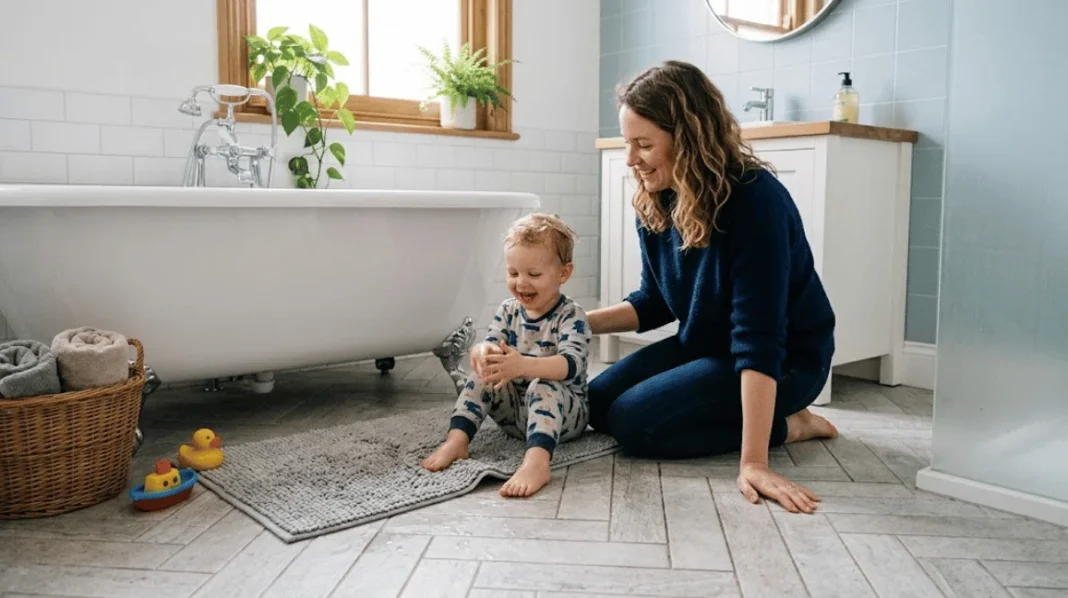
Choosing bathroom floor tiles is one of those renovation decisions where appearance is only half the job. The floor has to cope with splashes, humidity, regular cleaning and bare feet while still looking good beside the bath, shower, vanity and wall finishes. A beautiful tile that becomes dangerously slippery when wet or proves difficult to maintain can quickly turn into an expensive mistake.
The good news is that UK homeowners have far more choice than plain white ceramic squares. Porcelain, patterned ceramic, stone-effect designs, terrazzo looks, wood-effect planks, and traditional geometric styles can all work well when properly specified for floor use. The key is to judge every option by its material, wet-slip performance, size, finish, maintenance needs, and installation requirements rather than colour alone.
Quick answer: A bathroom floor should be water-resistant, durable and safe under wet bare feet. For most UK homes, matt or textured porcelain is a strong all-round choice because it handles moisture and daily wear well. Always check that a tile is floor-rated and review the manufacturer’s wet-slip test data before buying.
What makes a good bathroom floor tile?
A good bathroom tile combines practical performance with a surface you are happy to see every morning. It should be suitable for floors, able to withstand routine moisture, and easy to clean without constant specialist treatment. The finish also needs to provide appropriate grip when water reaches the floor, especially around showers and baths.
Do not assume that any product shown in a bathroom display is suitable underfoot. Some decorative ceramics are intended only for walls, while highly polished surfaces may look impressive in a showroom but become much less forgiving around water. Check the product specification for intended use, slip-resistance information, care requirements and compatibility with features such as underfloor heating before ordering.
Which bathroom floor tile material is best?
There is no single material that suits every bathroom and every budget. Porcelain is usually the easiest all-round recommendation, but ceramic and natural stone remain useful choices when their strengths match the project. Comparing the practical differences first makes it much easier to narrow down colours and patterns later.
| Tile type | Main advantages | Points to consider | Best suited to |
|---|---|---|---|
| Porcelain | Dense, durable, low water absorption, huge design choice | Harder to cut and usually costs more to fit | Family bathrooms, en-suites, wet areas |
| Ceramic | Affordable, easy to cut, many colours and patterns | Must be specifically rated for floor use | Lower-budget renovations and lighter-use bathrooms |
| Natural stone | Individual appearance and premium feel | May require sealing and specialist maintenance | Character properties and luxury schemes |
| Mosaic | Useful around curves and shower falls, strong visual detail | More grout joints and slower installation | Shower floors, feature zones and compact areas |
| Patterned tiles | Adds character without extra decoration | Layout and cuts need careful planning | Victorian, period and eclectic bathrooms |
Porcelain bathroom floor tiles
Porcelain works particularly well in bathrooms because it is dense and highly moisture-resistant. It also comes in convincing marble, limestone, concrete, terrazzo and timber effects, so homeowners can achieve the look of a more demanding material without necessarily accepting the same maintenance burden. Its strength makes it especially useful in busy family bathrooms, where the floor is used daily.
Installation can be more demanding because porcelain is harder to cut than standard ceramic. Large-format porcelain also requires a particularly flat substrate for the finished surface to look even and to avoid excessive lippage between adjacent tiles. That extra fitting effort should be included when comparing apparently similar tile prices.
Ceramic bathroom tiles
Ceramic is often the more economical option and can be easier for an experienced DIYer or tiler to cut. Modern collections include everything from simple neutral squares to encaustic-style prints and traditional geometric patterns. The important distinction is that the exact product must be rated for floor use rather than assumed suitable because it belongs to a bathroom collection.
Ceramic can make particular sense in an en-suite or cloakroom where traffic is relatively light. It can also allow more of the renovation budget to be spent on fittings, lighting or storage without leaving the floor looking basic. Compare the tile specification rather than treating ceramic as a single performance category.
Natural stone
Marble, limestone, slate and other natural stones create depth and variation that printed tiles can only imitate. Each piece has its own markings, which is part of the appeal in traditional and higher-end bathrooms. The trade-off is that some stones need sealing, more careful cleaning, and ongoing maintenance to protect their appearance.
Stone also needs to be chosen for the exact environment rather than for appearance alone. A polished marble surface, for example, raises different slip and maintenance considerations from a textured slate finish. If low maintenance is high on your priority list, porcelain with a natural-stone effect is often easier to live with.
How slip-resistant should a bathroom floor be?
Slip resistance deserves more attention than almost any design detail because a bathroom floor is routinely exposed to water. The Tile Association notes that slip resistance can change significantly once water or other contaminants reach the surface, and its guidance uses Pendulum Test Values to classify slip potential. A PTV above 36 is described as low slip potential, 25–35 as moderate and 0–24 as high under the stated test system.
You may also see German ramp classifications such as R9, R10 or R11 on UK tile listings, but they should not be treated as interchangeable with Pendulum results. The Health and Safety Executive cautions that an R9 floor can be slippery when wet and recommends using the Pendulum method to assess slip resistance. Test conditions and intended use matter, so ask the supplier for wet-test data rather than relying solely on an R-number or the words “anti-slip”.
For an ordinary domestic bathroom, this does not mean simply buying the roughest tile available. Heavily textured surfaces can be harder to clean and may feel uncomfortable under bare feet, while a smoother matt tile may provide an effective compromise outside a walk-in shower. Wet rooms and open shower areas deserve particularly careful specification because water reaches the floor far more frequently.
Matt or gloss: which finish works better on the floor?
Matt finishes are generally easier to specify for a bathroom floor because they reduce glare and are available with a wide range of slip-resistance characteristics. They also work naturally with stone, concrete, terrazzo and wood-effect designs. A soft matt surface can make a contemporary bathroom feel calmer while hiding minor water marks better than a highly reflective finish.
Gloss and polished surfaces can make a room feel luxurious, particularly when used to imitate marble. The difficulty is that appearance does not indicate how the product behaves when wet, so a glossy tile requires especially careful scrutiny of its suitability for the floor and test information. If you love a polished design, consider using it on the walls and choosing a coordinating matt version underfoot.
What tile size is best for a small bathroom?
Small bathrooms do not automatically require small tiles. Large-format tiles can actually make a compact floor appear calmer because fewer grout lines interrupt the surface, particularly when the wall and floor colours are closely coordinated. The real limitation is whether the room layout allows sensible cuts around the toilet, vanity, doorway and shower without creating narrow slivers.
Smaller tiles are more useful where the floor has slopes, curves, or complex changes in level. Mosaic sheets are particularly practical on some shower floors because their small units can follow a fall towards the drain more easily than a large rigid tile. More joints also mean more grout to maintain, so this practical advantage needs to be balanced against cleaning preferences.
A useful approach is to dry-plan the room before committing to a format. Measure the full space, mark the major sanitaryware positions and work out where the visible cut edges will fall. Pageify’s existing guide to how to tile a bathroom covers the planning, preparation, layout and fixing stages in more detail.
Bathroom floor tile ideas that work in UK homes
Stone-effect porcelain is one of the easiest looks to integrate into a modern bathroom. Warm beige and limestone tones soften white sanitaryware, while cooler grey concrete effects suit black fittings, frameless shower screens and contemporary cabinetry. Keeping the floor relatively quiet also gives you more freedom to introduce stronger colours through paint, towels and accessories.
Patterned designs work particularly well in small bathrooms because a limited floor area allows the pattern to make an impact without overwhelming the room. Victorian-inspired geometrics, checkerboards and encaustic-style motifs can suit period terraces just as well as colourful contemporary schemes. Repeating one colour from the floor on a vanity unit or wall creates a more deliberate finished design.
Wood-effect porcelain provides another useful option when you want warmth without putting genuine timber in a splash-prone area. Plank formats can visually lengthen a narrow room and pair well with cream, sage, navy and warm-white schemes. Choose a design with varied grain prints and plan the plank sequence before installation so repeated patterns are not positioned conspicuously beside one another.
Can tiled bathroom floors be used with underfloor heating?
Tiles and underfloor heating can be an excellent pairing because ceramic and porcelain conduct heat effectively and do not insulate the room in the same way thick carpet does. Compatibility still needs to be confirmed for the exact tile, heating system, substrate, adhesive and grout being used. The installer should also follow the heating-system and tile-product manufacturers’ requirements for commissioning and temperature changes.
Planning the heating before laying the floor is far easier than deciding to add it afterwards. Floor build-up, insulation, levelling and thermostat positioning can all affect the finished job, particularly during a retrofit where door clearances and transitions into neighbouring rooms matter. Pageify’s guide to underfloor heating costs explains the main electric and water-based system choices to consider during renovation planning.
How much do bathroom floor tiles cost in the UK?
Tile prices vary widely depending on material, format, finish, and brand, so the showroom price is only one part of the budget. Checkatrade’s July 2026 porcelain-flooring guide gives representative supply-only figures of about £20 per m² for budget porcelain, £35 per m² for mid-range porcelain and £60 per m² for high-end porcelain. Its broader installed estimate for porcelain is around £60–£130 per m², with an average of about £90 per m², although preparation and unusually complex work can increase the total.
Budget separately for adhesive, grout, trims, old-floor removal, levelling, waterproofing where required and difficult cuts. Large slabs, mosaics and detailed herringbone or geometric patterns normally take longer to fit than straightforward rectangular layouts. Obtain itemised quotations so that a low labour price is not masking exclusions that will be added once the existing floor is lifted.
How many tiles should you order?
Start by multiplying the length by the width of the floor to find the area in square metres. Wickes recommends adding at least 10% for cuts and wastage, which also helps when a damaged tile needs replacing during installation. More complicated patterns or rooms with many awkward cuts may justify a larger contingency, so confirm quantities with your tiler before placing the order.
Buying the full quantity together is preferable because shade and calibre can vary between production batches. Keep several unused tiles after the work is complete rather than returning every spare box. A matching replacement can be difficult to find years later if a tile is cracked during plumbing or bathroom alterations.
Prepare the floor before worrying about the pattern
Even expensive tiles will perform poorly over an unstable or uneven base. The substrate needs to be sound, appropriately prepared, flat enough for the chosen format and compatible with the tile adhesive system. Large-format tiles are particularly unforgiving because small variations in the floor can become obvious across their longer edges.
This is also the stage to resolve leaks, damaged boards, unsuitable surfaces and major level differences. If you are installing a wet room, moving plumbing or changing electrical equipment near the bath or shower, the project may extend beyond simple cosmetic retiling and require appropriately qualified trades. GOV.UK notes that bathroom work involving plumbing or electrical alterations may fall under building-regulation requirements, depending on the work.
Choose grout as part of the floor design
Grout affects the appearance of a tiled floor far more than its narrow lines suggest. A grout close to the tile colour makes the whole surface appear calmer, while a strong contrast emphasises every shape and joint. Darker mid-tone grout is often more forgiving than bright white on a frequently used floor, although maintenance still matters.
The number and width of grout joints also change the visual character of the room. Rectified large-format porcelain can create a restrained contemporary look, while geometric tiles deliberately make the joint pattern part of the design. Always use grout suitable for the installation conditions and compatible with the tile, adhesive, and any heating system.
How to keep a tiled bathroom floor looking good
Regular cleaning is usually more effective than allowing soap residue, dust and body-care products to build up and then relying on aggressive chemicals. The Tile Association also points out that cleanliness affects floor safety because contamination can alter a surface’s slip resistance. Follow the tile and grout manufacturers’ cleaning instructions, particularly with natural stone and other materials that can react badly to acidic products.
Treat grout, sealants, and perimeter joints as components that require inspection rather than as parts of the floor that can be ignored indefinitely. Deal with cracks, failed silicone and persistent damp patches early, because they may indicate a problem beyond ordinary surface dirt. For routine product selection and cleaning considerations, Pageify also has a guide to choosing a bathroom cleaner for tiles and grout.
Common mistakes to avoid
Many disappointing tiled floors come from decisions made before the first tile is fixed. Choosing from a photograph, ignoring wet-slip information or budgeting only for the tile itself can create practical problems that outweigh any saving. A few checks before ordering can prevent most of the expensive surprises.
- Buying a wall-only tile for a floor.
- Choosing a polished surface without checking wet-slip performance.
- Assuming every product labelled “anti-slip” has been tested in the same way.
- Selecting very large tiles for an uneven floor without allowing for preparation.
- Forgetting waste, cuts, trims, grout, adhesive and levelling costs.
- Ordering different batches at different times.
- Choosing natural stone without understanding its sealing and cleaning needs.
- Adding underfloor heating after the tile specification and floor height have already been finalised.
- Focusing on fashionable colours while ignoring how easily the surface can be cleaned.
Frequently asked questions
What is the best tile for a bathroom floor?
Porcelain is usually the strongest all-round choice for a typical UK bathroom because it combines low water absorption, durability and extensive design choice. Matt and textured porcelain options are widely available, including convincing stone, marble, wood and terrazzo effects. The best individual product is still the one that is floor-rated and has suitable wet-slip performance for the intended use.
Do bathroom floor tiles need to be non-slip?
A bathroom floor should be selected with wet slip resistance in mind because splashes are unavoidable. Instead of relying solely on marketing terms such as “non-slip”, ask for recognised test data and consider how wet the particular area will become. Shower floors and wet rooms generally demand more attention to wet grip than a separate dry zone outside an enclosed shower.
Are large tiles suitable for a small bathroom?
Yes, large tiles can work very well in small bathrooms and may make the space look less visually busy because there are fewer grout lines. They do require a flat substrate and a layout that avoids unattractive narrow cuts around fixtures. Smaller tiles may be more practical where the floor needs to follow complex slopes or curves.
Can you tile over existing bathroom floor tiles?
Sometimes, but the existing surface must be secure, appropriately prepared and capable of supporting the new installation. Adding another layer also raises the finished floor, which can affect doors, thresholds, sanitaryware and transitions into adjacent rooms. Have the existing floor assessed rather than assuming tiling over it is automatically quicker or cheaper.
How much should I budget for porcelain floor tiles?
A 2026 Checkatrade guide places supply-only porcelain at roughly £20–£60 per m² across budget to high-end categories, while its typical complete porcelain-floor installation range is about £60–£130 per m². Real bathroom quotations can be higher when removal, levelling, difficult layouts, waterproofing or other remedial work is needed. Measure the area first and compare itemised local quotations rather than multiplying the retail tile price alone.
Final choice: put safety and practicality before the showroom effect
The best bathroom floor tiles are the ones that still feel like a good decision after several years of wet feet, cleaning and everyday use. For many UK households, a matt porcelain floor with documented wet-slip performance offers the easiest balance of durability, design flexibility and maintenance. Ceramic, mosaics and natural stone can be equally successful when their particular characteristics fit the room.
Before ordering, bring home samples and view them beside your sanitaryware, wall colour and cabinetry in both daylight and artificial light. Then check floor suitability, wet-slip data, cleaning instructions, underfloor heating compatibility, and the total installation cost. That process may take an extra evening, but it is far cheaper than choosing a beautiful floor twice.