
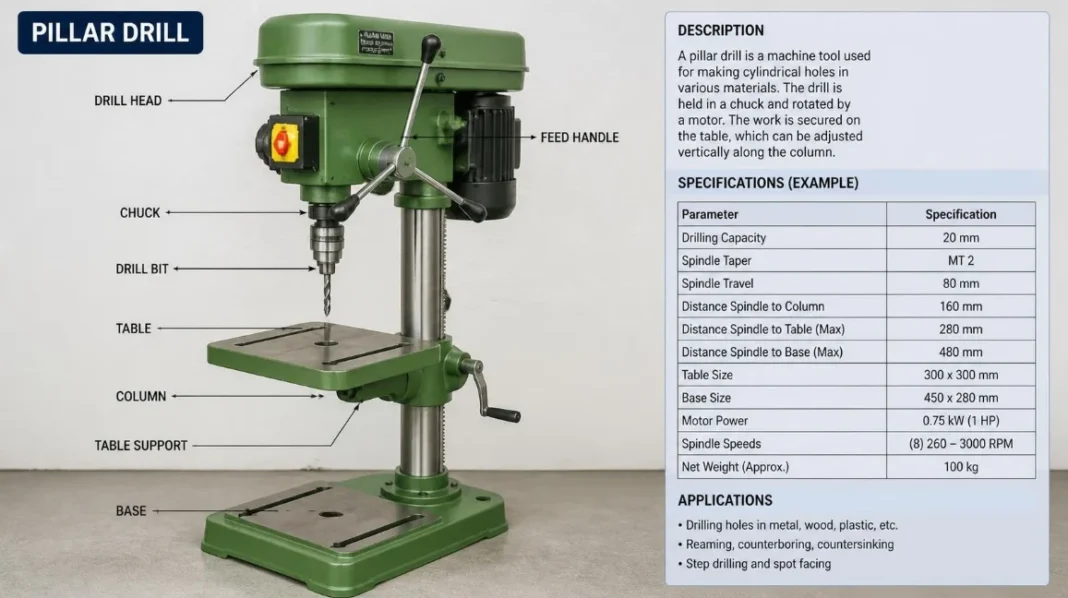
A pillar drill gives you far more control than a handheld drill when accuracy and repeatability matter. The fixed head, supported table, and controlled feed help keep holes straight and consistently positioned. That makes this machine useful for woodworking, metalworking, fabrication, repairs, and many home workshop projects.
Direct answer: A fixed drilling machine is ideal when you need straight, repeatable holes with controlled depth. UK buyers should compare drilling capacity, spindle travel, speed range, chuck size, table dimensions, motor power, and machine stability before choosing a model.
| Buying point | What to check | Why it matters |
|---|---|---|
| Machine type | Bench-mounted or floor-standing | Determines capacity, footprint, and portability |
| Chuck capacity | Commonly around 13mm or 16mm | Controls the range of standard bits you can fit |
| Spindle travel | Check maximum quill movement | Determines how deeply you can drill per stroke |
| Speed range | Lowest and highest RPM settings | Different materials and bit sizes need different speeds |
| Motor | Power and duty expectations | Matters more with larger bits and tougher materials |
| Table | Size, adjustment, and tilt | Affects support and positioning |
| Safety | Guarding, switchgear, secure mounting | Helps control risks around rotating machinery |
| Accessories | Vice, depth stop, light, laser | Can improve repeatability and usability |
Key Takeaways
- Choose the machine around your largest regular workpiece, not occasional small jobs.
- Bench models save space, while floor-standing machines usually offer greater capacity.
- A wide speed range matters when drilling both timber and metal.
- Spindle travel can matter more than headline motor wattage for many workshop jobs.
- Workpieces should be clamped rather than held by hand during drilling.
- Never wear gloves where they could become caught by the rotating chuck or bit.
- Good bits, correct speeds, and proper setup affect accuracy as much as the machine itself.
What Does a Fixed Workshop Drill Do?
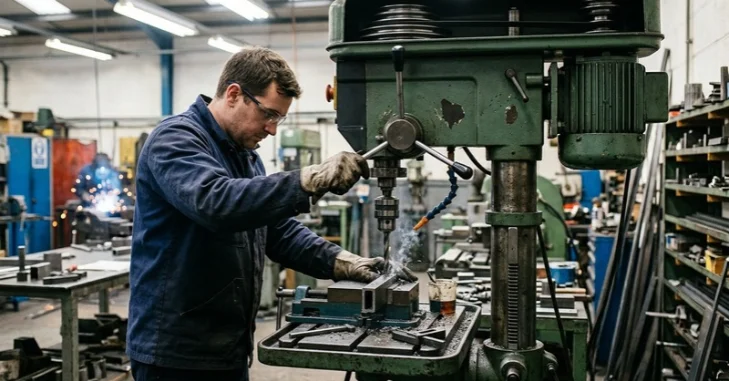
This type of drill holds the rotating bit in a fixed vertical head while the operator controls its downward movement. The workpiece sits on an adjustable table beneath the chuck. This arrangement removes much of the alignment error associated with drilling freehand.
The machine is especially useful for repeat work because you can set the workpiece, drilling depth, and table position. You can then make several similar holes without repeatedly judging the drilling angle. A suitable vice or clamping setup also keeps components positioned more consistently.
Pillar Drill UK suppliers sometimes use the terms bench drill, drill press, pedestal drill, and column drill for closely related machines. The names are not always applied consistently across retailers. Checking physical dimensions and capacity is therefore more useful than relying on the product name alone.
Pillar Drill vs Floor-Standing Machine
Bench-mounted models sit on a sturdy workbench and are normally bolted down. Their smaller dimensions make them practical for garages, sheds, and compact workshops. They can handle many woodworking and lighter metalworking jobs without occupying permanent floor space.
Floor-standing machines use a longer column and their own base. The extra height usually provides more room for larger workpieces and greater table adjustment. Their added mass can also improve stability during demanding work.
| Type | Main advantage | Main limitation | Well suited to |
|---|---|---|---|
| Bench-mounted | Compact and usually cheaper | Less vertical capacity | DIY, smaller woodworking, lighter fabrication |
| Floor-standing | Greater workpiece capacity | Needs more space | Larger projects and frequent workshop use |
Neither design is automatically better for every buyer. A compact machine can be the sensible choice when your projects use modest stock sizes. A larger model earns its space when deeper drilling or bulky components are routine.
How to Choose a Pillar Drill for Your Workshop
Start with the work you expect to do most often. Write down your common materials, largest hole diameter, workpiece size, and required drilling depth. This prevents attractive specifications from distracting you from practical capacity.
Check Spindle Travel
Spindle travel describes how far the chuck and bit can move downward during one feed. A longer stroke lets you drill deeper without repositioning the workpiece or table. This specification deserves close attention if you regularly work with thick timber or deep holes.
Some compact machines have enough motor power but limited downward travel. That combination can become frustrating on projects requiring deeper drilling. Compare travel figures before assuming two similarly powered machines offer the same capability.
Look at the Speed Range
Drilling speed should suit the material and the diameter of the cutter. Harder materials and larger drill diameters generally require slower spindle speeds. Smaller bits and softer materials can often run faster.
A machine with several belt-driven speeds gives you more control across varied tasks. Electronic variable speed can make adjustments quicker, although it may increase the purchase price. Always use the machine maker’s guidance and the drill-bit manufacturer’s recommended cutting speeds.
Compare Chuck and Taper Options
Chuck capacity tells you the normal range of straight-shank bits the machine can hold. Many hobby machines use a 13mm chuck, while larger workshop models may accept 16mm. The spindle or chuck mounting system can also affect future flexibility.
Machines using a Morse taper spindle may accept compatible tooling beyond an ordinary drill chuck. This can matter for users who expect their workshop requirements to expand. Check the exact taper specification because tooling systems are not universally interchangeable.
Consider the Table and Throat Capacity
A larger table gives bulky workpieces more support during positioning and clamping. Height adjustment should feel secure and manageable rather than awkward. A tilting table can help with angled drilling when the project genuinely requires it.
Throat capacity also deserves attention because it limits how far from an edge you can drill. Measure the types of panels, brackets, or components you normally use. A powerful machine is little help if the required hole cannot reach the drill axis.
Do Not Judge by Wattage Alone
Motor wattage gives some indication of available power, but it does not describe the whole machine. Construction, gearing, speed selection, spindle design, bearings, and rigidity all influence real workshop performance. A larger number on the box does not automatically produce a more accurate hole.
Think about duty as well as material. Occasional holes in timber create different demands from repeated drilling in steel. Buyers doing regular metalwork should pay particular attention to low-speed performance and machine rigidity.
What Materials Can You Drill?
Wood is a natural fit because the fixed setup makes accurate dowel holes, hardware holes, and repeated components easier. Different timber species still require suitable cutters and sensible feed pressure. Backing material can also reduce breakout when a bit exits the underside.
Metal can also be drilled effectively when the machine, cutter, speed, and workholding are suitable. Steel usually requires a slower approach than timber, especially as drill diameter increases. Appropriate cutting fluid may also be needed for particular metals and operations.
Many plastics can be drilled, although heat and cracking must be controlled. Use a cutter and speed suited to the specific material rather than assuming all plastics behave alike. Manufacturer guidance should take priority when working with unfamiliar sheet products.
If you are improving a garden workshop or shed, Pageify’s shed paint guide can help with protecting the surrounding timber structure. Good workshop conditions help tools and materials remain easier to manage. Planning the space as a whole is more useful than treating each machine as an isolated purchase.
Safety When Using a Pillar Drill
Rotating machinery creates entanglement, cutting, and ejection hazards, so safe setup matters every time. The UK’s Health and Safety Executive says static machinery should be installed correctly and remain stable. Guards and other safeguards should also be maintained and used as intended.
Secure the workpiece with a suitable vice, clamp, jig, or other method instead of relying on your hands. A drill can catch the material and make it rotate unexpectedly. Keep the work area clear and follow the operating instructions supplied with your particular machine.
Do not wear gloves close to a rotating drill or chuck where they could become entangled. HSE specifically warns that gloves can increase entanglement risk around drills and similar rotating machinery. Loose clothing, jewellery, and unsecured long hair can create similar hazards.
Use suitable eye protection and keep guards correctly positioned during normal operation. Stop and isolate the machine before cleaning, clearing problems, or making adjustments that require access to hazardous parts. Never defeat an interlock or remove a guard simply because it makes a job faster.
Workshop lighting matters too because markings and workpiece positions need to be easy to see. Pageify’s guide to battery-operated wall lights covers lighting choices for awkward spaces without convenient wiring. Any task lighting must still be positioned safely around moving machinery.
Features Worth Paying More For
A useful depth stop can save significant time when several holes need the same depth. It reduces repeated measuring and makes the machine more useful for joinery or batch work. Check whether the stop is simple to set and remains secure during use.
Variable speed is attractive for users who change materials or cutter sizes frequently. Belt changes are perfectly workable, but electronic adjustment removes repeated cover opening and pulley changes. The extra convenience matters more in a frequently used workshop than for occasional DIY.
Integrated work lights and laser guides can be useful, but they should remain secondary buying criteria. Mechanical accuracy, spindle condition, usable capacity, and stable workholding matter more. A laser cannot compensate for a poorly clamped component or unsuitable drill bit.
A good machine vice is often a more useful purchase than cosmetic electronic features. It supports safer workholding and can improve repeatability. Include essential accessories in your total budget rather than spending every pound on the drill itself.
New or Used?
Buying new usually gives you straightforward access to instructions, current safety equipment, warranty support, and replacement parts. It also makes comparing published specifications easier. This route can suit first-time owners who do not want to assess machine wear.
A used industrial or older British-made machine can offer substantial construction for the money. Condition matters more than reputation alone, however. Bearings, spindle play, damaged guards, switches, belts, chuck condition, table damage, and electrical safety all deserve inspection.
Do not buy an older machine assuming missing safety equipment is acceptable because of its age. Workplace equipment remains subject to safety requirements when used professionally. Home users should also avoid machines with unsafe modifications or missing guards.
Setting Up Your Workshop
Place the machine on a stable surface with enough room to position your normal workpieces. Bench models should be secured according to the manufacturer’s instructions. Floor models also need a stable installation that prevents unwanted movement.
Leave enough working space around the table, feed handles, motor, and belt cover. Poor positioning can turn routine adjustments into awkward reaches. Keep cables away from walkways and areas where swarf or offcuts collect.
If the machine sits inside a timber outbuilding, plan the room before filling every wall with equipment. Pageify’s wall panelling ideas also illustrate why measuring fittings, sockets, and fixed features before installation prevents later conflicts. The same planning principle applies to benches, storage, lighting, and machinery.
Is It Worth Buying One?
A fixed workshop drill makes sense when precision, repeatability, and controlled drilling matter more than portability. Frequent furniture making, metal fabrication, jig work, restoration, and repetitive hole patterns can all benefit. Occasional household drilling may not justify the space or cost.
For many home workshops, a solid bench model provides a useful balance between capability and footprint. Larger floor-standing machines become attractive when workpiece size or drilling capacity regularly exceeds a compact model. Buy for the work you genuinely perform rather than the largest specification you can afford.
Make Capacity Your Starting Point
The smartest purchase starts with your workpieces rather than a list of fashionable features. Measure the drilling depth, hole size, throat reach, and table space your normal projects demand. Then choose a machine that provides those capabilities with suitable speed control and stable construction.
Prioritise safe workholding, guarding, appropriate tooling, and a correctly installed machine after purchase. Those basics have a greater effect on useful results than lasers or digital displays alone. A well-chosen workshop drill should make accurate work easier without creating unnecessary complexity.
Frequently Asked Questions
What is a pillar drill?
It is a stationary drilling machine with a motorised spindle moving vertically towards a supported workpiece. The fixed arrangement makes straight and repeatable drilling easier than using a handheld tool. Models can be bench-mounted or floor-standing depending on their size and capacity.
Is a bench drill the same thing?
The terms often overlap in UK retail listings, but there is a practical distinction. Bench drills are normally compact machines designed for mounting on a workbench. Larger column or pedestal versions normally stand on their own floor base.
Can I use one for metal?
Yes, many suitable machines can drill metals when correctly equipped and operated. The drill bit, spindle speed, feed, workholding, and lubricant must suit the particular metal. Smaller hobby machines may become limiting when large holes or frequent steel drilling are required.
What speed should I use?
There is no single correct speed because drill diameter and material both matter. Larger cutters and harder materials generally need slower spindle speeds than small cutters in softer materials. Follow your machine instructions and the cutting-tool maker’s data rather than relying on one universal RPM chart.
Should I wear gloves while drilling?
Do not wear gloves where they could contact or become caught by rotating parts. HSE specifically identifies gloves as an entanglement risk around drills and similar machinery. Gloves may be appropriate for separate handling tasks only when the machine is safely stopped and the relevant risk assessment supports their use.
How much should I spend?
Prices vary widely because small hobby machines and industrial workshop equipment serve different jobs. Compare usable capacity and construction before setting a budget around a brand name or headline power figure. Remember to allow for drill bits, clamps, a vice, maintenance items, and suitable safety equipment.