
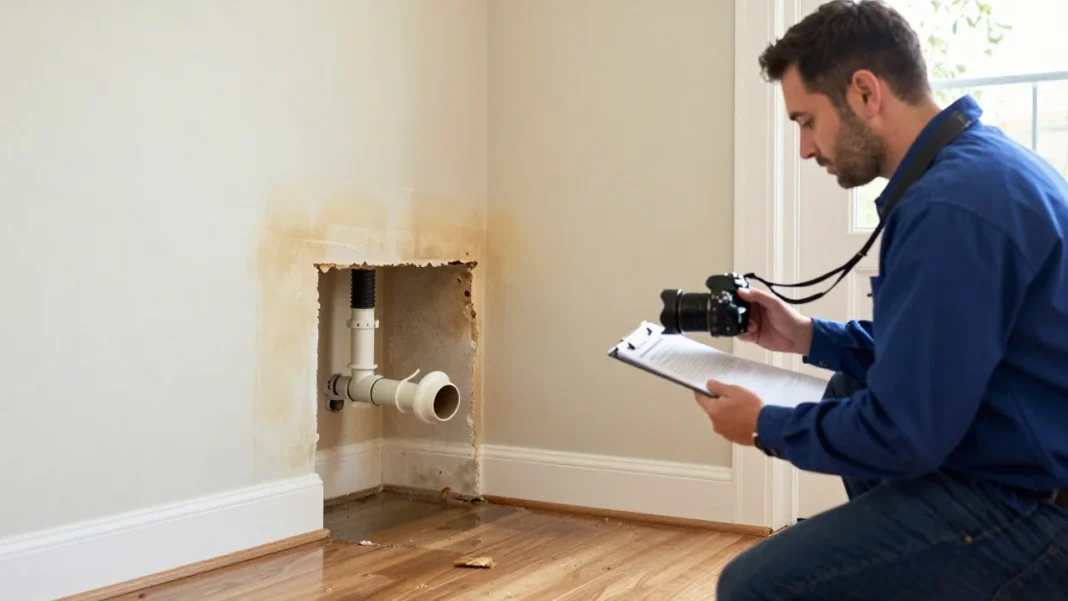
When a pipe fails and water spreads through a property, most policyholders assume the claim turns on the damage. It rarely does. It turns on the investigation that follows, and on how well the policyholder can answer the questions the insurer is about to ask.
Understanding what that investigation actually looks for is the difference between a claim that is paid in full and one that is reduced, disputed, or denied. It is also the clearest reason to have an public adjuster involved before the questions start.
The Four Questions Behind Every Plumbing Claim Investigation
Plumbing insurance claims are assessed against a consistent set of questions, and each one carries a coverage consequence:
- When did the failure occur, and when was it discovered? A long gap between the two invites an argument that the damage was allowed to worsen
- Was the failure sudden, or did it develop over time? Sudden and accidental discharge is typically covered, while gradual seepage is typically excluded [1]
- Was the system maintained? Corroded fittings, previously repaired sections, and deferred maintenance are all used to challenge coverage
- What damage is attributable to the water, and what existed beforehand? Pre-existing staining, settlement, or prior repairs become grounds to reduce the scope
Why Unrepresented Policyholders Answer Badly?
None of these questions are unfair. The problem is that they are asked of someone who has never handled a claim, often within days of a stressful event, and frequently in a recorded statement or written response that becomes part of the claim file permanently.
An imprecise answer about when a stain was first noticed can convert a covered sudden failure into an excluded gradual loss. A casual mention of a previous plumbing repair can be used to argue deferred maintenance. Once those statements are in the file, they are difficult to walk back.
What a Public Adjuster Does Differently?
Licensed in California under the Insurance Code [2], a public adjuster represents the policyholder rather than the insurer. On plumbing losses, that work begins before the investigation does: establishing the timeline with dated evidence, documenting the failure point and any retained pipe section, mapping moisture behind walls and under floors, and separating water-related damage from anything pre-existing.
The result is that the insurer’s questions are met with documentation rather than recollection. California’s claims regulations require insurers to acknowledge a claim within 15 calendar days and reach a coverage decision within 40 days of receiving proof of loss [3], and a complete, evidenced submission is what makes those timelines work in the policyholder’s favour rather than against them. Allied Public Adjusters handles plumbing and water intrusion claims across California, including claims where causation has already been challenged, and cases where a recorded statement has already been given.
Common Questions
Should a policyholder give a recorded statement on a plumbing claim? Policies generally require cooperation, but preparation matters. Reviewing the timeline and evidence beforehand avoids imprecise answers that affect coverage.
Can a denied plumbing claim be reopened? Often yes, particularly where the denial rested on a causation finding that additional documentation can challenge.
Key Takeaways
- Plumbing claims are decided by the insurer’s investigation, not simply by the visible damage.
- Timing, causation, maintenance history, and pre-existing damage are the four areas insurers examine.
- Imprecise early statements can convert a covered sudden failure into an excluded gradual loss.
- Documentation gathered before the investigation replaces recollection with evidence.
- Insurers must acknowledge claims within 15 calendar days and decide within 40 days of proof of loss.