

The University of Law (ULaw) is a leading private institution in the United Kingdom dedicated to legal education and professional training. With a strong vocational focus, it prepares students for careers as solicitors, barristers, and other legal professionals through practical, skills-based learning.
Building on a long history rooted in the former College of Law, ULaw combines academic study with real-world application, ensuring graduates are ready for the demands of the modern legal sector. Its emphasis on employability, industry partnerships, and flexible learning options makes it a popular choice for aspiring legal practitioners both in the UK and internationally.
| Category | Summary |
| Type | Private law university |
| Location | UK (multiple campuses) |
| Established | 1962 (as College of Law) |
| Focus | Vocational legal training |
| Programs | LLB, LLM, GDL, SQE prep |
| Teaching Style | Practical, skills-based |
| Facilities | Moot courts, legal labs |
| Admission | Varies by course |
| Career Support | Strong employer links |
| Regulation | OfS, SRA, BSB oversight |
| Learning Modes | On-campus, online, blended |
| Global Reach | International partnerships |
| Key Strength | Employability-focused |
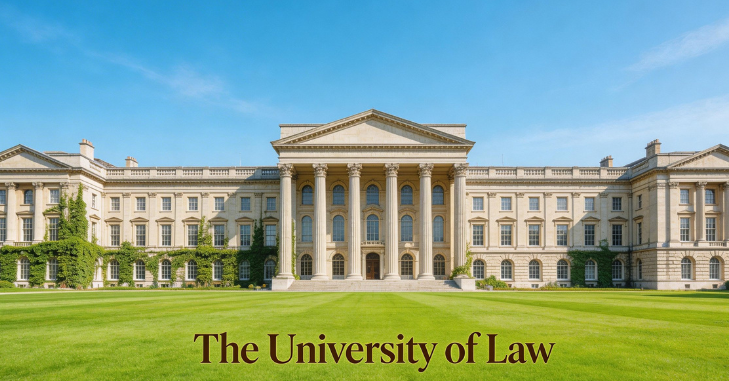
The University of Law

The University of Law (ULaw) is a private university in the United Kingdom specializing in legal education. With a history that stretches back over a century, ULaw has built a reputation for vocational training, professional preparation, and strong ties to the legal profession.
It focuses on delivering courses that prepare students for careers as solicitors, barristers, legal executives, and other roles within the justice system, as well as related fields such as business, compliance, and policing.
History and Background
- The roots of the University of Law go back to the College of Law, established in 1962 as the College of Law of England and Wales. However, ULaw traces a longer lineage through predecessor institutions and legal education traditions in Britain.
- The College of Law was formed through the merger of several regional law schools that had offered practical legal training for solicitors and other legal professionals.
- For decades, the College of Law functioned as a provider of vocational legal training, including the Solicitors Qualifying Examination (pre-2011, the Legal Practice Course, LPC) and the Bar Professional Training Course (BPTC), as well as continuing professional development (CPD) for practising lawyers.
- In 2006, the College of Law was placed into private ownership and restructured as The College of Law Ltd, which later sought university title. In 2012, the institution was granted the power to award its own degrees, enabling it to validate and award them.
- The College changed its name to the University of Law in 2012 when it gained university status—becoming the first for-profit provider to receive such recognition in England.
- This rebranding reflected a strategic decision to expand academic provision, increase research capacity, and enhance the institution’s standing in higher education while maintaining its strong vocational focus.
- Over the years, ULaw has continued to evolve its curriculum to reflect changes in the legal profession. It has adapted to reforms in solicitor training, including the introduction of the Solicitors Qualifying Examination (SQE), and has invested in simulation-based teaching, practical skills training, and partnerships with law firms and regulatory bodies.
- The university emphasizes employability, practical experience, and preparing graduates for professional practice.
Campuses and Locations

The University of Law operates multiple campuses primarily across England and Wales, with additional international presence through partnerships and online delivery. Its physical footprint is designed to serve students in major legal and commercial centers, aligning campus locations with regional legal markets and employer networks.
Key UK Campuses
Key campuses in the UK include London (Bloomsbury and Moorgate sites), Birmingham, Bristol, Leeds, Liverpool, Manchester, Newcastle, and Guildford. Each campus aims to provide a blend of professional facilities, such as moot courts, legal skills suites, negotiation rooms, and law clinics, alongside lecture theatres and study spaces.
The London campuses serve as important hubs for students seeking proximity to City law firms and barristers’ chambers; other campuses have strong regional employer links and attract students who wish to work in local markets.
International Partnerships
In addition to its UK campuses, ULaw has maintained international activities through partnerships and franchised programs with institutions abroad. These collaborations extend ULaw’s curriculum and professional training to students and legal professionals in other countries.
Online and Blended Learning Provision
The university offers a robust online and blended learning provision that enables students outside the UK to access ULaw qualifications. This digital delivery model supports flexible study patterns and broadens access to vocational legal education.
Global CPD and Short Courses
The university’s continuing professional development and short-course offerings have a global reach, catering to solicitors, barristers, and legal professionals seeking specialist knowledge or accreditation. These programs are available in various formats to meet the needs of busy practitioners worldwide.
Courses and Programs Offered
The University of Law (ULaw) offers a vocational portfolio covering undergraduate degrees, integrated master’s, postgraduate taught programs, professional legal qualifications, doctoral study, and short CPD courses. The common focus across offerings is practical skills and employability to prepare students for legal and related professions.
- Undergraduate Degrees (LLB): ULaw’s flagship undergraduate degree is the LLB, designed for students progressing to professional training or pursuing legal knowledge for other careers.
- The curriculum covers core subjects contract, tort, criminal, constitutional/administrative, property, equity, and trusts, and often includes practical skills, employability modules, placements, and optional topics such as commercial law, IP, employment, and human rights. Some campuses offer combined degrees (e.g., law with business).
- Postgraduate and Conversion Courses: Postgraduate options include LLM specialisms (such as Commercial Law, Corporate Finance, International Business Law, and Human Rights), MA programs, and conversion courses, such as the Graduate Diploma in Law (GDL) for non-law graduates.
- These programs blend doctrinal study with applied projects, research, and practitioner engagement.
- Professional Legal Training: ULaw is a major provider of professional training. It delivers SQE preparation (SQE1 and SQE2), tailored LLM routes aligned to the SQE, and flexible delivery (full‑time, part‑time, online).
- Historically, it offered the LPC and bar training equivalents; current offerings focus on preparing candidates for regulated qualification pathways and practical skills assessments.
- Teaching Approach and Facilities: Teaching is experiential and practice‑oriented: mooting, advocacy, negotiation, legal clinics, practical assessments, and placements form core methods. Campuses provide mock courtrooms, interview/negotiation suites with recording for feedback, digital research tools, and skills labs.
- Practitioners frequently contribute through teaching, guest lectures, and mentoring to ensure contemporary, practice‑relevant learning.
The University of Law is widely recognized for its strong emphasis on employability and professional readiness, making it a preferred choice for students who aim to enter the legal profession directly. Unlike traditional universities, ULaw focuses on practical training through simulated courtrooms, real-world case studies, and close collaboration with law firms and industry experts.
This career-driven approach ensures that graduates are not only academically qualified but also equipped with the practical skills and confidence required to succeed in competitive legal environments.
Admission Requirements

Admission requirements at the University of Law vary by program, level of study, and applicant background. Below is a general guide to typical requirements; applicants should consult specific course pages for detailed, up-to-date criteria.
Undergraduate Entry (LLB)
School-leavers typically need A-levels (or equivalent UCAS tariff points). Requirements vary by campus and competition. International qualifications (e.g., IB) are accepted, and non-native English speakers must provide proof of English proficiency (e.g., IELTS or equivalent).
Graduate Entry (GDL/LLM)
Non-law graduates usually take the Graduate Diploma in Law (GDL) to convert to law; a UK bachelor’s degree (or equivalent) is the usual entry requirement. LLM applicants generally need a recognized law degree or a related undergraduate degree plus relevant experience for some specialisms. International applicants must provide validated foreign qualifications, transcripts, and references; English-language proof is required where applicable.
Professional Training
Practice-focused programs typically require a qualifying law degree or completion of the GDL. SQE preparation courses accept a range of academic backgrounds and may include interviews, references, or evidence of experience. ULaw offers integrated and modular routes to suit different candidates following the SQE reforms.
Apprenticeships and Workplace Routes
Apprenticeships require employer sponsorship, a contract of employment, eligibility to work in the UK, and meeting apprenticeship age criteria. ULaw delivers the academic component in partnership with employers.
International Students
International applicants should confirm the country-specific entry requirements and the recognition of their qualifications. Campus-based students must meet UK visa and immigration requirements; the university provides guidance.
Assessment, Progression, and Awards
Assessments mix written exams, coursework, case analyses, practical tasks (advocacy, interviewing), group projects, and reflective portfolios. Professional programs may include competency-based pass/fail assessments. Degree classifications and award criteria follow UK higher‑education standards.
Careers, Employability, and Professional Links
- A central selling point of the University of Law is its focus on employability. Careers services support students with CVs, interview preparation, mock assessments, and targeted employer events.
- The university runs careers fairs, on-campus recruitment events, and simulated assessment centers to prepare candidates for solicitor and paralegal recruitment processes. Its close relationships with law firms, chambers, in-house legal teams, and public sector employers enable strong placement, internship, and pupillage pathways.
- ULaw often collaborates with professional bodies and regulators, including the Solicitors Regulation Authority (SRA) and professional associations, to align its training with regulatory expectations. For continuing professional development, firms frequently use ULaw as a training partner for induction programs, compliance updates, and specialist legal training.
Quality and Regulation
As a UK university, ULaw is subject to quality assurance and regulatory frameworks overseen by bodies such as the Office for Students (OfS) and, formerly, the Quality Assurance Agency (QAA).
Professional qualifications and training routes are subject to oversight by regulatory bodies such as the Solicitors Regulation Authority for solicitor qualifications and the Bar Standards Board for barrister training.
The introduction of the SQE has led to changes in how solicitor qualifications are regulated, and ULaw has adapted to offer approved or recommended SQE preparation routes.
Conclusion
The University of Law occupies a distinctive niche in UK higher education as a professionally oriented institution specializing in legal education and training.
Its long history in vocational training, multiple campuses in legal and commercial centers, a broad suite of undergraduate, postgraduate, and professional programs, and strong employer links make it a compelling option for students aiming for a practice-focused legal career.
Prospective students should consider program content, costs, campus location, and the balance between academic study and vocational preparation when deciding whether ULaw aligns with their career ambitions. For up-to-date details on specific courses, fees, campus facilities, and entry requirements, consult the University of Law’s official website or contact its admissions office directly.
Want to know about The Ultimate Guide to Crafting a Student CV Template Check out our Education category.
FAQs
As well as achieving an overall 5-Star rating as an institution and for the Law subject, we have achieved 5 Stars in: Teaching. Employability. Online Learning.
Established in 1962, The University of Law (ULaw) is a private, for-profit higher education institution based in the vibrant town of Guildford, South East England. With a student population ranging from 15,000 to 19,999, ULaw is a large, coeducational university officially recognized by the Privy Council.
You can study law and business at our two London campuses: Bloomsbury and Moorgate. Our campuses are situated in central London, alongside some of the best universities, colleges, and schools in the world, making them an attractive place to study and experience student life.