
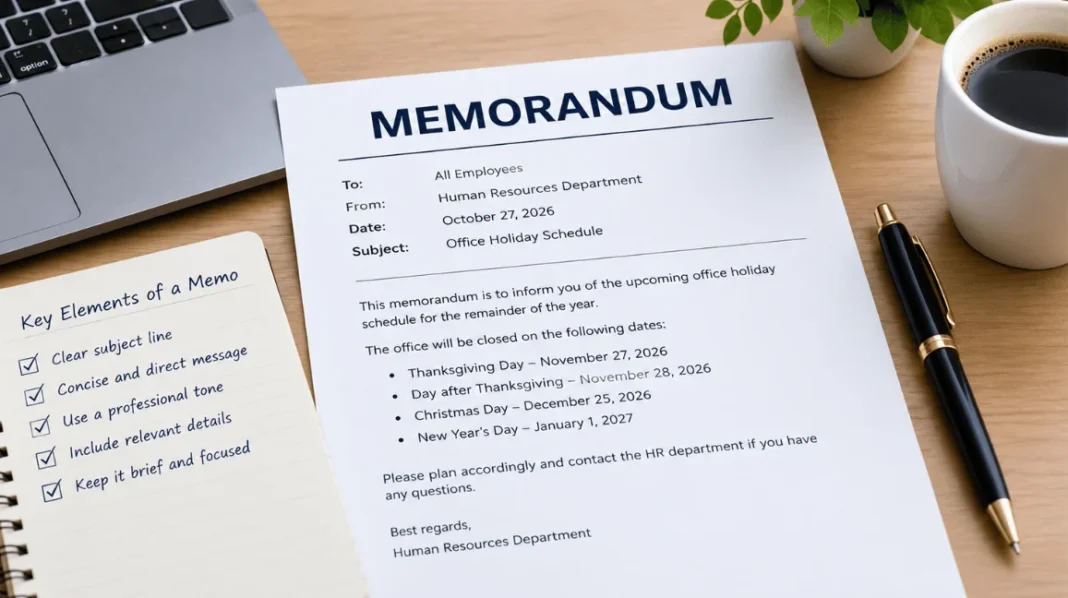
Knowing how to write a memorandum helps you communicate important workplace information clearly and professionally. A good memo states its purpose quickly, gives relevant details, and tells readers what happens next. It usually avoids greetings, lengthy introductions, and formal letter-style endings.
To write an effective memo, start with To, From, Date, and Subject details. State the main purpose immediately, then provide essential background and any required action. Keep the language clear, professional, and concise. Finish by confirming deadlines, responsibilities, or contact details so readers know exactly what to do next.
Memorandum writing at a glance
| Element | What to include | UK writing tip |
|---|---|---|
| To | Recipient or relevant team | Use names, departments, or “All Staff.” |
| From | Sender’s name and role | Include your job title when useful. |
| Date | Distribution date | Use an unambiguous date format. |
| Subject | Exact topic | Make it specific and action-focused. |
| Opening | Purpose and key message | Put the main point first. |
| Main body | Context, facts, or instructions | Keep information relevant. |
| Action | What readers must do | Include owners and deadlines. |
| Closing | Final clarification | Give a contact for questions. |
A workplace memo is usually an internal communication rather than a formal external letter. Current UK guidance commonly uses a heading containing the recipient, sender, date, and subject. Greetings and conventional letter sign-offs are generally unnecessary.
What is a memorandum?
A memorandum, commonly shortened to “memo,” is a structured message used within an organization. Businesses may use one for policy changes, announcements, decisions, project updates, instructions, or requests. Its format helps readers identify the purpose and required action quickly.
The format is more formal than a casual team message but usually simpler than a business letter. Memos normally focus on one subject and present important information near the beginning. Adobe’s UK guidance also recommends keeping workplace memos concise and easy to scan.
This meaning should not be confused with a UK memorandum of association. That document has a specific legal purpose when forming a limited company. GOV.UK states that online company registration creates it automatically, while postal applications use the prescribed template.
When should you use a memo?
Use a memo when information needs more structure or permanence than a routine chat message. It works well when several colleagues need the same instructions, decision, or official update. The format also gives readers an easy record they can refer to later.
Common uses include:
- announcing a new workplace policy;
- explaining a process change;
- assigning responsibilities;
- providing a project update;
- requesting information or approval;
- confirming a management decision;
- announcing an internal event;
- explaining a deadline or procedure.
Choosing the right recipients matters as much as writing the message itself. A clearly named point of contact can reduce confusion when readers need clarification. Pageify’s guide to the POC meaning in a job explains how designated contacts support workplace accountability.
How to write a memorandum in 7 steps
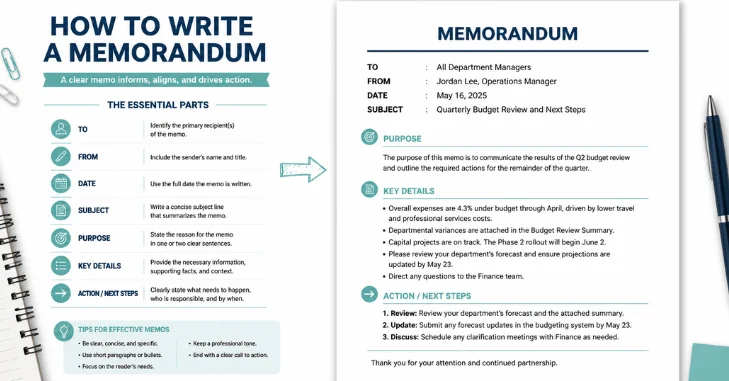
A strong memo follows a predictable sequence, which makes drafting easier. Each stage should move the reader towards understanding the message or completing an action. The following process works for most internal business communications.
What you’ll need before you start
Gather the facts, names, dates, deadlines, and supporting documents before drafting. Decide exactly who needs the information and what they should do afterwards. You should also confirm who can answer questions about the subject.
1. Identify the purpose
Write one sentence explaining why the memo needs to exist. This sentence helps you remove background details that do not support the main objective. It also makes the opening easier to write.
Ask what readers should know, decide, or do after reading. If you cannot answer that question clearly, refine the purpose before continuing. A memo covering several unrelated subjects will usually become difficult to follow.
2. Name the correct recipients.
Place the intended reader or group after the “To” label. You can name an individual, department, project team, management group, or the entire workforce. Avoid sending the document to people who do not need the information.
Think about knowledge levels within the group before choosing technical language. Explain unfamiliar abbreviations where necessary and avoid unexplained internal jargon. This approach is especially useful when several departments receive the same message.
3. Write a specific subject line.
The subject should tell readers what the document concerns before they read the body. “Office Update” gives little useful information, while “New Visitor Sign-In Process From 2 November” sets clear expectations. Specific wording also makes the document easier to find later.
Include the main action or effective date when either detail matters. Keep the wording short enough for readers to scan. Avoid vague subjects such as “Important Information” or “Please Read.”
4. Put the main message first.
Open with the information readers most need to know. Explain the decision, change, request, or announcement within the first few sentences. Do not spend several paragraphs building towards the central point.
For example, a policy memo might begin with its effective date and principal change. A project memo could state the current status and next milestone. Readers can then understand the message even before reviewing supporting detail.
5. Add only useful background.
Provide enough context to explain why the message matters. Include relevant facts, previous decisions, dates, evidence, or operational reasons. Leave out history that does not affect the reader’s understanding or actions.
Use headings or bullet points if several related details need attention. This structure can make policy changes and procedures easier to follow. It also reduces the chance of an important instruction becoming buried inside dense prose.
For workplace procedures, consistency between written instructions and practical responsibilities is especially important. Pageify’s article on UK workplace first-aid readiness illustrates why named roles, procedures, and clear responsibilities matter.
6. State the required action.
Tell readers exactly what they need to do after reading. Name the action, responsible person, and deadline whenever those details apply. Avoid endings that leave the next step open to interpretation.
For example, write “Managers must return completed schedules by 4 pm on Friday.” That instruction is clearer than asking teams to respond “as soon as possible.” Precise deadlines help colleagues prioritize work and reduce follow-up messages.
7. Review and distribute the memo.
Check names, dates, figures, links, and instructions before sending the final version. Remove repeated points and simplify sentences that take too long to understand. Confirm that every recipient has the information needed to act.
Choose a distribution method appropriate for your workplace. A memo can be printed, placed within an email, or shared through an internal system. Keep formatting consistent so recipients recognize official communications quickly.
Businesses also benefit from applying similar clarity to outward-facing messages. Pageify’s guide on marketing a small local business explains why relevant information should match the intended audience.
Standard memo format
Most business memos can use a simple four-line heading. Indeed’s UK guidance includes recipient, sender, date, and subject information within the standard structure. The body then explains the reason, details, and requested action.
MEMO
To: [Recipient or team]
From: [Your name and job title]
Date: [Day Month Year]
Subject: [Specific subject]
After the heading, open with the main purpose and most important information. Follow with relevant context, decisions, or supporting details. Finish with the action, deadline, or contact point.
A conventional memo normally does not need “Dear…” at the beginning. It also does not usually need “Yours sincerely” or another letter-style closing. The heading already identifies the sender and intended audience.
Memorandum example for a UK workplace
The following example shows the structure applied to a common office situation. Notice how it gives the change, effective date, required action, and contact details. It also avoids unnecessary greetings or lengthy explanations.
MEMO
To: All Office Staff
From: Hannah Clarke, Operations Manager
Date: 25 October 2026
Subject: New Visitor Sign-In Procedure From 2 November
From 2 November, all visitors must sign in at reception before entering staff areas. Reception will issue a temporary visitor badge, which must remain visible throughout the visit. Hosts remain responsible for collecting their visitors from reception.
The change gives staff a consistent process for identifying visitors inside the building. Contractors attending scheduled maintenance must follow the same procedure. Deliveries made only to reception do not require visitor registration.
Department managers should brief their teams before 30 October. Staff expecting external guests should provide visitor names to reception before arrival. Questions about the process should be sent to the Operations Manager.
This example works because every paragraph has a clear function. The first gives the change, the second supplies context, and the third sets actions. Readers can therefore understand both the decision and their responsibilities quickly.
Common memo-writing mistakes
The biggest mistake is hiding the main message beneath unnecessary background. Readers should not have to search several paragraphs to discover what has changed. Put essential information near the beginning and supporting detail afterwards.
Another problem is an unclear call to action. Phrases such as “please deal with this accordingly” do not identify an owner, task, or deadline. State exactly what action is required and when it must happen.
Poor subject lines can also weaken an otherwise useful message. The subject should help someone understand and retrieve the document later. Include the topic, change, or deadline instead of using a generic label.
Finally, avoid turning a straightforward memo into a lengthy report. Adobe recommends concise workplace memos and commonly describes the format as a one-page document. Longer or complex evidence may work better as an attachment or separate report.
Memo vs email: what is the difference?
Email describes a delivery method, while a memo describes a type of structured business communication. You can therefore distribute a memo through email without turning it into an ordinary email message. The structured heading and formal purpose still distinguish it.
Routine questions and brief conversations usually suit normal email or workplace messaging tools. Significant policy changes, formal instructions, or decisions may benefit from memo formatting. The choice depends on importance, audience, and whether employees need a lasting internal record.
Frequently asked questions
How to write a memorandum for work?
Start with To, From, Date, and Subject details, then state the main purpose immediately. Add only the background needed to understand the issue and required action. Finish with clear responsibilities, deadlines, and a contact for questions.
What are the main parts of a memo?
A basic memo contains a heading, opening statement, supporting information, required action, and closing clarification. The heading usually identifies the recipient, sender, date, and subject. Some organisations may add references, attachments, or copied recipients.
Does a memo need a greeting?
A standard business memo normally does not use a greeting such as “Dear Team”. It begins with the heading and moves directly into the message. This format keeps the document concise and distinguishes it from a formal letter.
Does a memo need a signature?
A conventional memo usually identifies the writer within the “From” line. For that reason, a letter-style signature at the end is normally unnecessary. Organisations can still apply their own approval or authentication procedures.
How long should a memo be?
Most routine workplace memos should be short enough to scan. Adobe’s UK guidance recommends a concise, commonly one-page format for ordinary business communications. Complex supporting material can be attached separately when necessary.
Is a memorandum of association the same as a workplace memo?
No, they have different purposes. A workplace memo communicates information internally, while the company document relates to forming a UK company. GOV.UK states that its wording and format are prescribed for relevant registrations.
Make every memo easy to act on
Effective business writing should make the reader’s next step obvious. Start with the point, provide only useful context, and finish with specific actions or responsibilities. That approach produces shorter documents and reduces avoidable follow-up questions.
Before sending your next workplace communication, check the recipient, subject, facts, and deadline once more. Make sure another person could understand the required action without asking you to explain it. For more practical UK-focused business content, explore Pageify’s wider business resources.