

Bedroom wallpaper can change a room’s mood without a full renovation. The right pattern can add warmth, depth, colour, or a stronger focal point. Your best choice depends on room size, natural light, furniture, and the atmosphere you want.
Wallpaper also gives you more decorating options than a single paint colour. You can create a feature wall, cover every wall, or highlight an awkward architectural area. This guide explains how to choose a design that works in a real UK bedroom.
Bedroom Wallpaper at a Glance
| Choice | Works well for | What to consider |
|---|---|---|
| Floral wallpaper | Traditional, romantic and nature-led rooms | Choose scale carefully in smaller spaces |
| Striped wallpaper | Small or low-ceiling bedrooms | Vertical lines can emphasise height |
| Geometric designs | Modern and contemporary rooms | Keep surrounding furnishings simple |
| Textured wallpaper | Calm, neutral interiors | Lighting changes how texture appears |
| Mural wallpaper | Statement walls and larger bedrooms | Measure the wall accurately before ordering |
| Dark wallpaper | Cosy and dramatic schemes | Balance it with suitable lighting |
| Neutral wallpaper | Relaxed and flexible bedrooms | Add texture to prevent a flat appearance |
| Full-room wallpaper | Cocooning, coordinated interiors | Lower-contrast patterns are easier to live with |
Direct answer: The best bedroom wallpaper combines a pattern you enjoy with colours that suit the room’s light and furnishings. Soft florals, stripes, textured neutrals, and nature-inspired designs suit restful schemes. Bolder murals and geometric prints work well behind a bed. Always test samples in daylight and evening light before ordering.
Key takeaways
- Start with the mood you want rather than choosing a pattern in isolation.
- Consider natural light before committing to dark, cool, or highly saturated colours.
- Use pattern scale to complement the room’s size and proportions.
- A feature wall isn’t your only option because full-room schemes can feel more cohesive.
- Test physical samples beside your bedding, flooring, curtains, and furniture.
- Measure every wall carefully and check the manufacturer’s roll dimensions before buying.
11 Bedroom Wallpaper Ideas for UK Homes
There isn’t one pattern that works in every bedroom. Room proportions and existing furniture can completely change how a design feels. These ideas provide useful starting points for different spaces and decorating styles.
1. Make the wall behind your bed the focal point
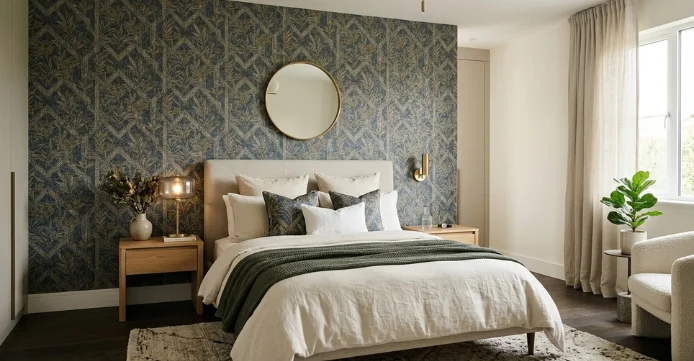
The wall behind the headboard is a natural place for a stronger design. Your bed already draws attention, so wallpaper reinforces an existing focal point. It also keeps a busy pattern away from your direct view while sleeping.
This approach works especially well with florals, murals, geometrics, and larger botanical prints. Keep adjoining walls quieter when the chosen design contains several colours. Pull one shade from the paper into cushions or bedding for a coordinated finish.
2. Use soft florals for a relaxed bedroom
Floral designs can feel traditional, contemporary, or playful depending on their scale and colour. Muted botanical patterns suit bedrooms because they introduce detail without demanding constant attention. Look for dusty greens, gentle blues, warm creams, or restrained pinks for a softer scheme.
Large flowers tend to make a stronger decorative statement than small repeating motifs. Smaller patterns can create an even background when used across several walls. Consider the furniture style before deciding which approach suits your room.
3. Try stripes to change the room’s proportions
Striped paper offers a simple way to introduce pattern without complicated motifs. Vertical stripes can emphasise height, making them useful in bedrooms with lower ceilings. Wider stripes usually create a more contemporary effect than narrow traditional designs.
Horizontal lines can make a wall appear broader, but placement needs careful thought. Pair striped walls with mostly plain bedding to avoid competing patterns. A restrained two-colour design gives you plenty of flexibility when accessories change.
4. Create a statement with a bedroom mural
A mural turns one wall into a large decorative scene rather than a repeating pattern. Landscapes, woodland scenes, abstract artwork, and oversized botanicals can all work behind a headboard. The result can replace the need for several smaller pieces of wall art.
Measure the wall carefully, since murals often match specific dimensions. Think about where furniture will hide important parts of the image. Keep the strongest visual detail visible above and around your bed.
5. Choose textured neutrals for subtle depth
Pattern doesn’t need to dominate a bedroom to make a difference. Papers that imitate linen, woven fibres, plaster, or other subtle textures can add depth. They work particularly well when you prefer neutral interiors but find plain painted walls too simple.
Texture becomes more noticeable when light falls across the wall from the side. Bedside lamps and wall lights can therefore become part of the decorating scheme. Pageify’s guide to battery operated wall lights explains cordless options for bedside and accent lighting.
6. Wrap all four walls for a cohesive look
A single statement wall isn’t always the most balanced approach. Covering every wall can make a bedroom feel more considered and enclosed. The technique works particularly well with small-scale patterns and lower-contrast colours.
Repeating the design around the room removes the sharp visual break between wallpaper and painted walls. Choose carefully if your bedroom contains several large pieces of furniture. A quieter print usually gives wardrobes, beds, and textiles enough visual space.
7. Bring nature indoors with botanical patterns
Leaf, woodland, meadow, and tree motifs can create a softer connection with the outdoors. Green isn’t essential because botanical patterns also appear in blue, cream, brown, and monochrome palettes. Choose colours that match your flooring or larger furniture.
Natural wood furniture works particularly well with leafy and landscape-inspired designs. Linen, cotton, wool, and woven accessories can continue the natural theme. Keep the colour palette controlled so the finished room remains restful.
8. Use darker wallpaper for a cosy bedroom
Dark wallpaper can make a bedroom feel intimate rather than cramped when used thoughtfully. Navy, forest green, charcoal, burgundy, and deep brown can provide a strong backdrop. Pattern prevents these colours from looking like a single heavy block.
Lighting becomes particularly important with deeper shades. Use several light sources instead of relying only on the ceiling fitting. Mirrors and lighter textiles can also stop the finished room from feeling visually heavy.
9. Add personality with geometric wallpaper
Geometric patterns work well in contemporary bedrooms because they provide clear structure. Curves can soften an angular room, while straight lines create a sharper architectural effect. Scale determines whether the finished result feels quiet or energetic.
Use a bold geometric pattern on one wall when your furniture already has strong shapes. Smaller, low-contrast geometry can work around the entire bedroom. Keep other patterned surfaces restrained unless their colours and proportions clearly relate.
10. Combine wallpaper with wall panelling
Wallpaper above painted panelling gives you pattern without covering the entire wall. This arrangement can suit period-inspired bedrooms and modern interiors alike. It also lets you introduce stronger colours below the paper without making the scheme feel crowded.
Choose the panelling colour after examining the wallpaper closely. Taking a less obvious secondary colour from the pattern can create a more interesting combination. Test both finishes together before decorating the complete room.
11. Consider the ceiling as a fifth wall
Wallpaper doesn’t have to stop where the wall meets the ceiling. A papered ceiling can create an enclosed, decorative effect, especially in bedrooms with interesting rooflines. Softer designs are usually easier to live with above the bed.
This technique needs careful preparation because installation is more demanding than papering a vertical wall. Check the manufacturer’s hanging instructions before starting. Consider professional installation for expensive paper or complicated ceiling shapes.
How to Choose Bedroom Wallpaper for a Small Room
Small bedrooms don’t automatically need tiny patterns or white walls. A larger pattern can work because fewer repeats remain visible across a short wall. What matters more is contrast, furniture placement, and uninterrupted wall space.
Low-contrast patterns usually create a calmer background than designs with sharp colour changes. Light colours can help maintain an airy appearance where daylight is limited. Darker schemes can still work when you deliberately want a cosy, enclosed feeling.
Avoid judging a design from a small online thumbnail. Order a sample and place it on different walls for several days. View it during the morning, afternoon, and evening before deciding.
Feature Wall or Wallpaper on Every Wall?
A feature wall suits people who want a clear focal point without surrounding the room in pattern. It also gives you more freedom to choose a dramatic print. The wall behind the bed is usually the easiest position to integrate with furniture.
Full-room wallpaper creates a different effect because the pattern becomes the background rather than a single decorative panel. Small motifs, soft stripes, and low-contrast botanicals are strong candidates. This approach can make the bedroom feel intentionally designed rather than divided into separate surfaces.
Consider your future decorating plans before deciding. A feature wall makes it easy to change the surrounding paint. Full coverage creates stronger visual continuity but requires more paper, preparation, and installation time.
How Colour Changes the Feel of Bedroom Wallpaper
Colour influences the feel of a room as much as pattern. Warm beige, clay, cream, and muted pink can create a softer atmosphere. Blues and greens often suit nature-led schemes and coordinate easily with wood.
Dark shades produce more contrast and can make decorative details stand out. Pale colours reflect more available light and often suit rooms with smaller windows. Neither approach is automatically better, so judge colours inside the actual room.
Remember that bulbs can alter how wallpaper appears after sunset. Warm lighting can change cool whites and blues considerably. Compare your sample under the lights you normally use before ordering.
How to Match Wallpaper with Your Bed and Furniture
Start with the largest fixed elements because replacing them usually costs more than changing accessories. Consider your bed frame, flooring, wardrobes, and curtains before selecting the final paper. Pageify also explains how the right bed frame affects a bedroom when planning your sleeping space.
A heavily upholstered headboard can compete with an intricate pattern behind it. Simpler wallpaper may create a better balance in that situation. Plain wooden or metal beds often leave more freedom for detailed patterns.
You don’t need to match every colour perfectly. Repeating two or three related tones usually creates enough connection. Use bedding, cushions, lampshades, and curtains to carry those colours around the room.
Measuring Before You Buy
Measure the width and height of every surface you plan to cover. Don’t assume all rolls provide the same usable coverage. Width, length, pattern repeat, and matching method can affect how much you need.
Patterned paper often produces more waste because adjoining drops need alignment. Large repeats can require noticeably more material than plain or random-match designs. Check the manufacturer’s calculator or coverage instructions for the exact product.
Buying enough from the same batch is sensible where batch numbers apply. Small colour differences between manufacturing runs can become visible once installed. Keep unopened spare material until the room is finished and checked.
Common Bedroom Wallpaper Mistakes to Avoid
Choosing from a screen alone is one of the easiest mistakes to make. Screen brightness and photography can change how colours appear. A physical sample gives you a much better idea of colour, scale, and texture.
Another mistake is treating wallpaper separately from the rest of the room. The bed, lighting, curtains, floor, and storage all contribute to the finished scheme. Plan these elements together before committing to an especially bold design.
Poor preparation can also undermine expensive wallpaper. Walls should meet the manufacturer’s preparation requirements before hanging begins. Follow the specific instructions for your chosen paper, paste, wall surface, and installation method.
Frequently Asked Questions About Bedroom Wallpaper
What bedroom wallpaper is best for a relaxing room?
Low-contrast designs in muted colours are a useful starting point for a calmer bedroom. Soft botanicals, restrained stripes, and textured neutrals can provide interest without dominating the room. Your personal response to a colour or pattern matters too.
Is bedroom wallpaper suitable for a small room?
Yes, wallpaper can work successfully in compact bedrooms. Consider the pattern scale, available daylight, furniture, and contrast rather than following a strict small-pattern rule. Test a generous sample before buying several rolls.
Which wall should be wallpapered in a bedroom?
The wall behind the bed is the most natural choice for a feature wall. It already contains the room’s main visual anchor and works well with stronger patterns. Other walls can work when architecture or furniture creates a better focal point.
Is it better to wallpaper one wall or the whole bedroom?
Neither option is universally better. One wall suits dramatic patterns and creates a defined focal point. Covering every wall can produce a softer, more immersive result with a carefully chosen design.
What wallpaper makes a bedroom look bigger?
Lower-contrast colours and designs with visual space can help a compact bedroom feel less crowded. Vertical stripes may emphasise ceiling height, while lighter colours can preserve brightness. Furniture scale and layout also influence how spacious the room feels.
Make Your Wallpaper Work with the Whole Bedroom
Choose bedroom wallpaper by looking at the entire room rather than an isolated sample. Start with light, proportions, furniture, and the mood you want to create. Then narrow your options by colour, pattern, scale, and placement.
Bring several samples home before making the final decision. Check each one beside your bed, on your flooring, with your curtains, and under your evening lighting. A little testing can prevent an expensive design from feeling wrong after installation.